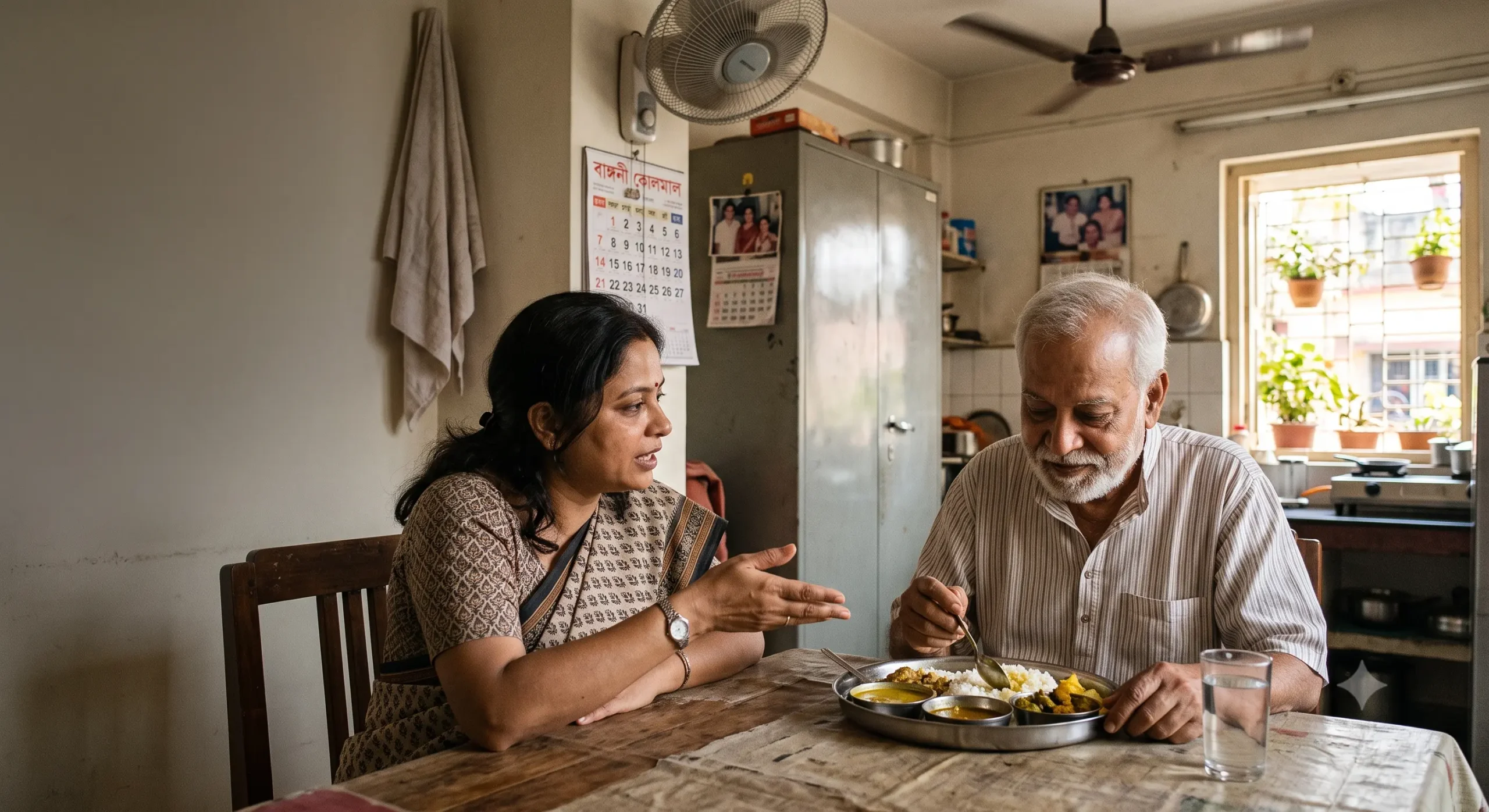
“She’s eating dal and rice every day, she’s fine.” It’s the most common thing families say when asked about an elderly parent’s nutrition — and it is very often wrong. Eating something is not the same as eating enough. A parent can be having three meals a day and still be nutritionally at risk, because what actually matters is quantity, protein content, hydration, and whether intake has changed from what it used to be.
Unlike a fall or a hospital admission, nutritional decline in the elderly is quiet. It doesn’t announce itself. It shows up months later as unexplained weakness, a fall, slower recovery from illness, or a hospital admission that takes far longer to bounce back from than it should — by which point it’s being treated as a crisis instead of caught as a trend.
Why nutrition risk goes unnoticed
Three assumptions tend to hide a real problem:
“They’re eating home food, so they’re fine.” Home-cooked doesn’t automatically mean adequate. Portion sizes shrink with age and appetite loss, and families rarely measure how much is actually being eaten versus how much is being served.
Weight loss gets attributed to “old age.” Some weight change with age is expected. Ongoing, unintentional weight loss is not — it’s one of the more reliable warning signs of an underlying problem, nutritional or otherwise, and it’s one of the easiest signs for a family to miss because clothes are simply “getting looser” gradually rather than all at once.
Nobody is actually tracking intake. A family member visiting once a week, or a caretaker managing meals without training in what to watch for, has no baseline to compare against. Decline that happens gradually, day by day, is very hard to notice without deliberately checking.
Signs worth paying attention to
Why elderly parents are physiologically more at risk
This isn’t just a matter of habits. Ageing itself changes how the body manages appetite and hydration, in ways families rarely account for.
- Thirst sensation reduces with age — an elderly person can be genuinely dehydrated without feeling thirsty, which means “just drink more water” doesn’t happen naturally the way it does in a younger person
- Taste and smell decline — food that used to taste rich and appealing can taste bland, which reduces motivation to eat, independent of appetite
- Dental problems and poor-fitting dentures — make chewing effortful enough that a person quietly avoids harder-to-eat foods, including many protein sources
- Medication side effects — several common medications cause nausea, dry mouth, or appetite suppression as a side effect; if your parent is on multiple medications, this is worth reviewing alongside intake (see our article on polypharmacy in elderly patients)
- Low mood affecting appetite — loneliness and depression commonly reduce appetite and interest in food; see our article on loneliness and depression in elderly parents for more on recognising this
The Indian context makes this harder to catch
Two patterns specific to Indian households make nutritional decline particularly easy to miss. First, the cultural assumption that home-cooked meals are inherently sufficient means intake is rarely actually measured — families ask “did you eat?” and accept a yes, without asking what or how much. Second, as joint family structures have changed and adult children move to other cities or abroad, the person managing daily meals is often a caretaker or domestic help without training in recognising nutritional warning signs — they can tell you a parent “ate lunch,” but not whether the portion or protein content was adequate.
For families managing this from abroad
If your parent lives with a caretaker and you’re checking in by phone or video call, general questions won’t surface a real problem. A few things that will:
- Ask the caretaker directly and specifically — not “is she eating well” but “what did she actually eat at lunch today, and how much of it did she finish”
- Ask for a photo of the plate before and after a meal occasionally — this reveals actual intake far better than a verbal report
- Watch for changes in video calls — a face that looks visibly thinner, looser clothing, or reduced energy in how your parent moves and speaks are all things a camera picks up over time even when a phone call doesn’t
- Ask about water and fluid intake specifically, not just food — this is the piece caretakers most often don’t think to report on
If you notice unintentional weight loss, consistent difficulty eating or swallowing, or your parent seems weaker than they were a few months ago, that’s the point to arrange a proper assessment rather than continue watching from a distance. Nutritional decline that’s caught early is usually straightforward to address; nutritional decline that’s caught after a fall or hospitalisation is a much harder problem to recover from.
What a structured nutritional assessment includes
A proper nutritional evaluation for an elderly patient goes beyond asking what they ate yesterday. It typically involves tracking weight against a documented baseline rather than a visual impression, reviewing actual daily intake patterns, checking for chewing or swallowing difficulty, reviewing current medications for anything affecting appetite or absorption, and looking at hydration status directly. Where relevant, it’s done alongside a broader review, since nutrition, medication, and mood are frequently connected — a parent who’s depressed may be eating less, and a parent eating less may become more fatigued and withdrawn, and untangling which came first matters for getting the right treatment in place.
If something about your parent’s eating or drinking has changed — even something that seems small — that’s worth raising with a specialist rather than waiting to see if it resolves on its own.
Leave a Reply
You must be logged in to post a comment.